Medicare Costs for 2026 from Medicare.gov
Medicare costs change every year. Understanding the 2026 premiums, deductibles, and coinsurance amounts helps with healthcare budgeting. Most people pay no premium for Part A, while the standard Part B premium is $202.90 monthly. Higher-income beneficiaries pay additional amounts.
Who Should Read This
This publication is essential reading for anyone approaching age 65 or already enrolled in Medicare. Current Medicare beneficiaries need this information to understand what they will pay in 2026. People turning 65 in 2026 should review these costs when deciding whether to enroll in Medicare or delay enrollment. Adult children helping parents with Medicare decisions will find this useful for financial planning. Retirees budgeting for healthcare expenses need these figures to prepare for the coming year.
When This Applies
This publication contains the official Medicare costs for calendar year 2026. These costs take effect on January 1, 2026. The information is time-sensitive and specific to 2026 only. Medicare costs are updated annually, so a new version of this publication is released each year in the fall. The costs listed here remain in effect through December 31, 2026.
Quick Overview
This official Medicare publication provides all the costs beneficiaries will pay for Medicare coverage in 2026. It covers premiums, deductibles, and coinsurance amounts for Medicare Part A, Part B, Part C, and Part D. The publication is a concise two-page fact sheet designed for quick reference when planning healthcare budgets.
Key Takeaways
- The standard Part B premium increases to $202.90 per month in 2026, up $17.80 from 2025
- The Part B annual deductible rises to $283 in 2026, an increase of $26 from the previous year
- Most people pay no premium for Part A, but those who must purchase it pay up to $565 monthly in 2026
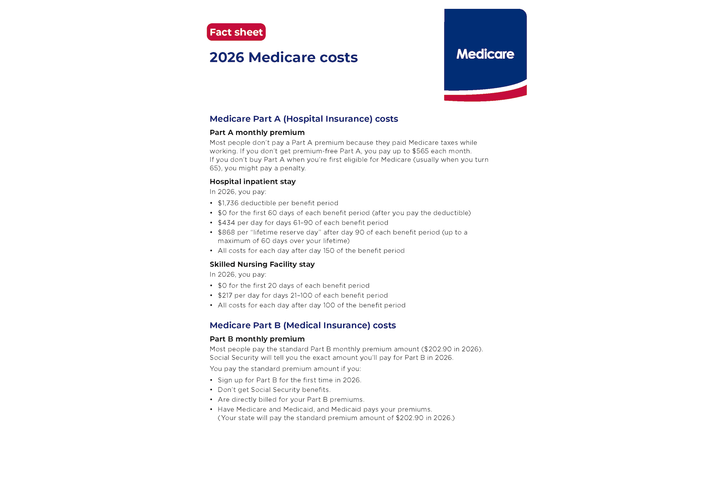
- The Part A hospital deductible increases to $1,736 per benefit period in 2026
- Higher-income beneficiaries pay additional amounts on top of standard premiums for both Part B and Part D
- Income-related adjustments are based on tax returns from two years prior, meaning 2024 income determines 2026 premium amounts
- Skilled nursing facility coinsurance increases to $217 per day for days 21-100 in 2026
Publication Summary
Medicare costs change annually, and understanding these changes helps beneficiaries plan their healthcare budgets effectively. The 2026 Medicare costs reflect adjustments across all parts of the program.
Part A covers hospital stays, skilled nursing facility care, hospice services, and some home health care. Most beneficiaries receive Part A without paying a monthly premium because they or their spouse paid Medicare taxes during their working years. This is known as premium-free Part A. However, individuals who do not qualify for premium-free Part A must purchase coverage, with monthly premiums reaching up to $565 in 2026. Enrolling late in Part A can result in permanent penalties that increase these costs.
When hospitalized, beneficiaries face a deductible of $1,736 per benefit period. A benefit period begins upon hospital admission and ends after 60 consecutive days without inpatient hospital or skilled nursing care. After paying this deductible, the first 60 days of hospitalization are fully covered. Extended hospital stays require coinsurance payments: $434 per day for days 61 through 90, and $868 per day for lifetime reserve days beyond day 90. Beneficiaries have only 60 lifetime reserve days available over their entire lifetime. After exhausting these days, all hospital costs must be paid out of pocket.
For skilled nursing facility stays, Medicare covers the first 20 days completely when medical criteria are met. Days 21 through 100 require a daily coinsurance payment of $217. After 100 days in a benefit period, Medicare no longer helps with skilled nursing costs and the beneficiary becomes responsible for all expenses.
Part B covers physician services, outpatient care, preventive services, medical equipment, and diagnostic tests. Unlike Part A, all Part B enrollees pay a monthly premium. The standard premium is $202.90 per month in 2026. This represents an increase of $17.80 from the 2025 standard premium of $185.00. Most beneficiaries pay this standard amount, including those enrolling in Part B for the first time, those not receiving Social Security benefits, those billed directly for Part B, and those with both Medicare and Medicaid.
Beneficiaries with higher incomes pay additional amounts through the income-related monthly adjustment amount, commonly called IRMAA. Medicare determines these adjustments by reviewing tax returns from two years earlier. For 2026 premiums, the government examines 2024 income levels. Individual filers with modified adjusted gross income above $109,000 pay higher premiums, as do joint filers with income above $218,000. The premium increases in steps, ranging from $284.10 per month for those in the lowest additional bracket up to $689.90 per month for the highest-income beneficiaries.
Before Medicare Part B begins paying for services, beneficiaries must meet an annual deductible of $283 in 2026. This represents a $26 increase from the 2025 deductible of $257. After meeting this deductible, Original Medicare typically covers 80 percent of approved costs for most outpatient services, leaving the beneficiary responsible for the remaining 20 percent coinsurance.
Medicare Advantage Plans, also known as Part C, provide an alternative way to receive Medicare benefits through private insurance companies. These plans must cover everything Original Medicare covers and often include additional benefits such as prescription drug coverage, dental care, or vision services. Each Medicare Advantage Plan sets its own premium, which varies based on location and included benefits. Beneficiaries enrolled in Medicare Advantage Plans must continue paying their Part B premium in addition to any plan premium. Tools for comparing plan premiums are available at Medicare.gov/plan-compare.
Part D prescription drug coverage operates through private plans, each with its own premium structure. The government establishes a national base premium amount, which serves as a benchmark for calculating late enrollment penalties and income-related adjustments. For 2026, the national base premium is $38.99. Higher-income beneficiaries pay income-related monthly adjustment amounts on top of their chosen plan's premium. These adjustments use the same income thresholds as Part B and range from $14.50 to $91.00 per month depending on income level.
Frequently Asked Questions
Do most people pay a premium for Medicare Part A? No, most people receive Part A premium-free because they or their spouse paid Medicare taxes while working. Only those who do not qualify for premium-free Part A need to purchase coverage.
How is the income-related monthly adjustment amount determined? Medicare reviews tax returns from two years prior to determine if a beneficiary owes additional amounts. For 2026 costs, the government examines 2024 income levels reported to the IRS.
What happens if someone delays enrolling in Medicare? Late enrollment can result in permanent penalties that increase premiums for as long as a person has Medicare. The penalty amounts depend on how many months enrollment was delayed.
Are Medicare costs the same for everyone? No, while standard premiums and deductibles are set amounts, higher-income individuals pay more through income-related monthly adjustment amounts for both Part B and Part D coverage.
Do Medicare Advantage Plans replace the Part B premium? No, beneficiaries enrolled in Medicare Advantage Plans must continue paying their Part B premium in addition to any premium charged by the Medicare Advantage Plan.
Related Resources
- Medicare & You 2026 (Publication 10050) - The official Medicare handbook covering all Medicare programs and services
- Understanding Medicare Advantage Plans (Publication 10116) - In-depth guide to Part C options
- Choosing a Medigap Policy: A Guide to Health Insurance for People with Medicare (Publication 02110) - Information about supplemental insurance options
Access the Full Publication
| Standard Print (PDF) |
Publication Number: 11579
Publication Date: December 2025
Length: 2 pages